
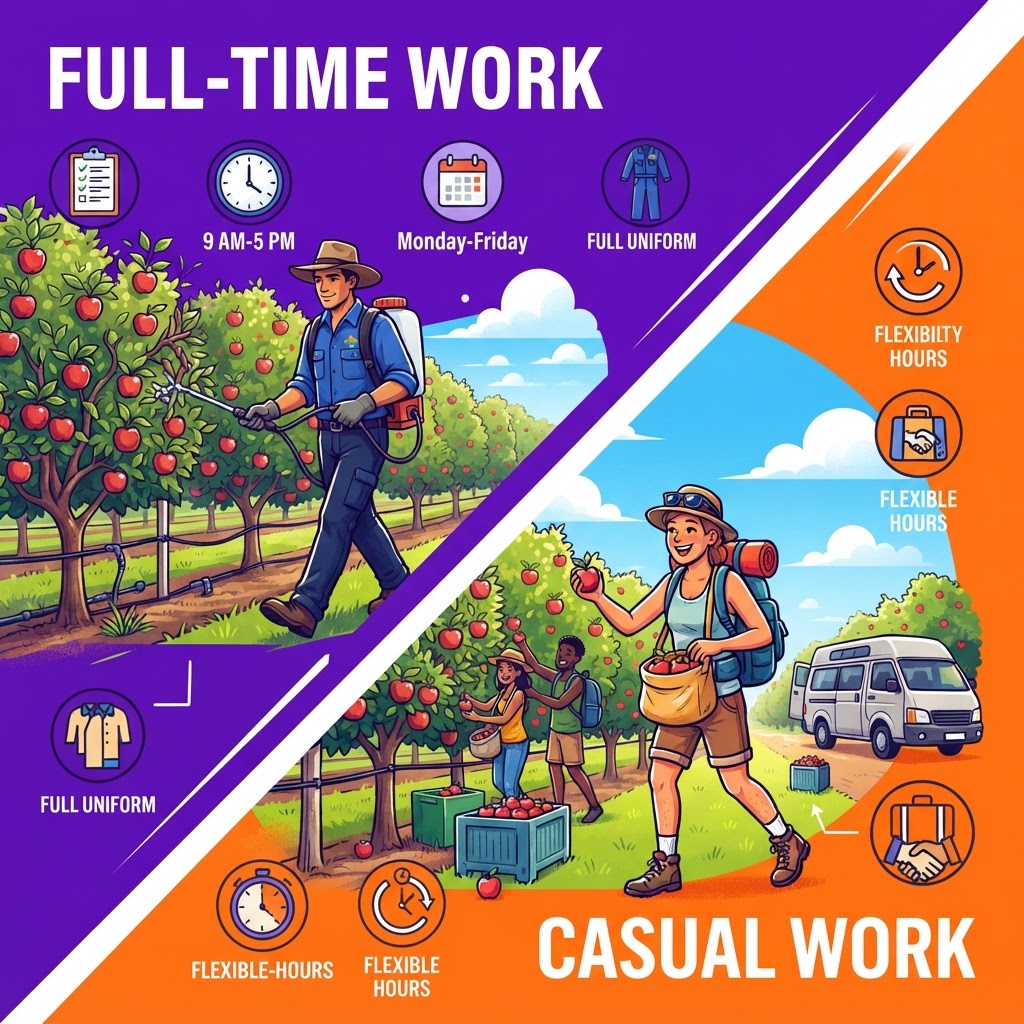
A common question is whether full-time, part-time or casual farm work counts faster towards your 88 days. The answer depends on whether your actual days and shifts add up to the full-time equivalent over the qualifying period — not on the "casual" label alone.
Days are calendar days, not shifts
Your 88 days are counted as calendar days during a period of employment in specified work — including weekends — not as individual shifts. The test is whether you worked the equivalent of the normal days and shifts of a full-time employee in that role over three months. See our counting guide for the full rule.
Full-time work
A full-time pattern (for example Monday–Friday) usually meets the equivalent in about three calendar months, because the calendar days — including weekends — count during continuous employment.
Part-time and casual work
Part-time and casual work can still count. If your normal days are fewer than a full-time employee's, the equivalent can accumulate over a longer calendar period. There is no universal "casual hours" shortcut, and not every continuous employment automatically counts every calendar day — what matters is whether your actual pattern adds up to the full-time equivalent over the qualifying period.
Paid rest days
Paid public holidays and paid sick days during a continuous employment period can count. Unpaid days do not.
Which is faster?
A full-time-equivalent pattern usually reaches 88 calendar days sooner. Part-time or irregular patterns can still work, but generally need a longer calendar period to accumulate the equivalent.
Track every payslip
Whatever your arrangement, record each payslip and confirm each postcode is regional with the Postcode Finder, then track your running total with the 88 Days Calculator.
Estimates only. Confirm the current rules on the Home Affairs specified work page.